
Venice Company Analysis and Data Available in Plushcap
July 5, 2026 by Matt Makai
Venice is a privacy-first AI model hosting platform founded in 2024. For open-weighted models, Venice hosts them in its own data centers. Closed-source models from OpenAI, Anthropic, and Google are available but routed to those providers for input and output. Venice's pitch is that privacy is enhanced because their users' input is encrypted client-side, routed through an external proxy before calling the model, and then nothing is stored on Venice's systems. They are essentially providing the infrastructure similar to Together.AI or Baseten but with a layer of obfuscation and then a pledge to not log the input and output data, as shown in the graphic below from their privacy overview page.
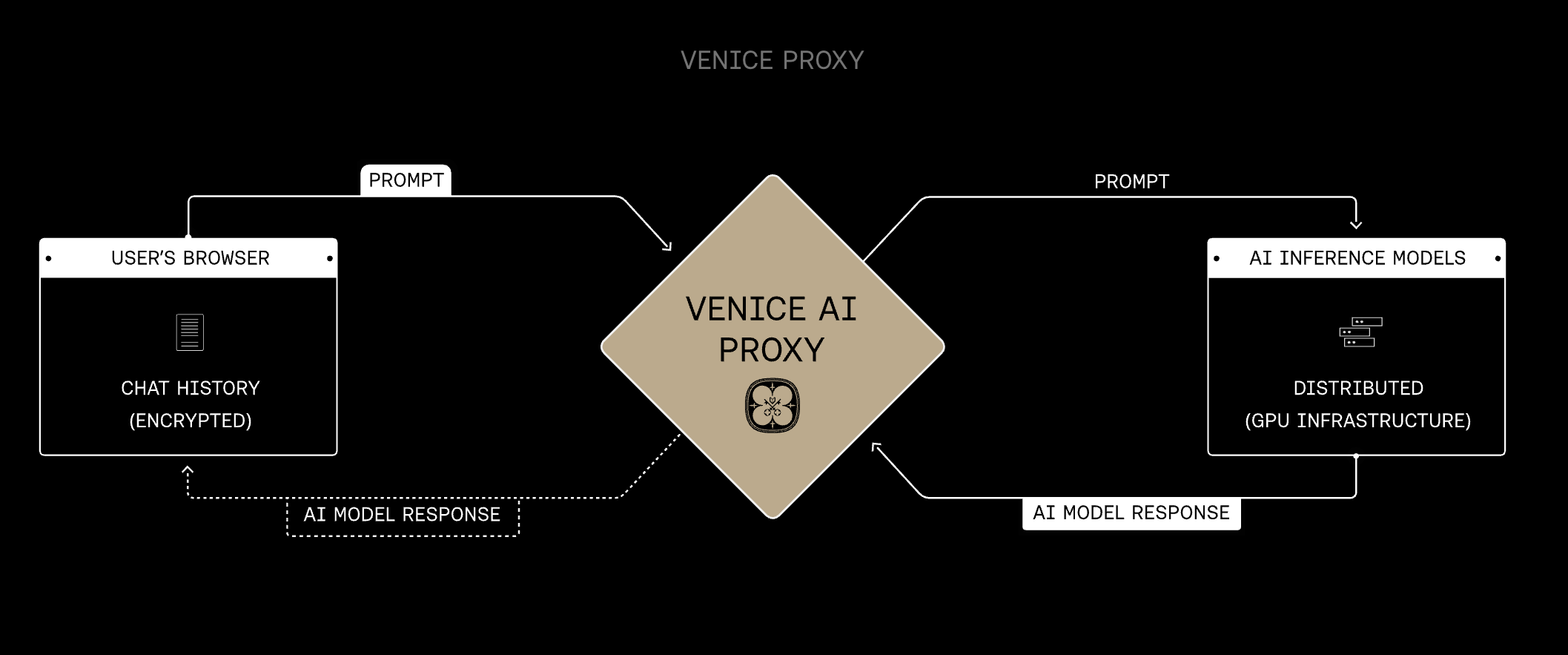
This "privacy-first approach" is actually a pretty good pitch, especially for larger companies wary of how their data is handled, as well as companies outside of the United States that are looking for additional layers of security as they build out their AI governance. It also gives Venice an opportunity to further productize security and privacy features, such as when they launched end-to-end encryption in March 2026.
That said, Venice is likely facing two significant challenges already with this model. First, is that some percentage of the privacy-conscious customers are scammers and spammers that want to minimize their chances of being caught. Second, is the push by the US government for frontier models to require know-your-customer (KYC) processes to match people and organizations with their appropriate usage of AI models. That said, these are also opportunities for them to lean into these trending areas and come up with solutions that other competitors won't match because they don't want to use privacy as their strategy.
Content and Product Direction
Venice's blog content output is very light (only 15 posts published in 2026 as of July 4th), compared to 387 posts by Hugging Face and other competitors with ramped-up content marketing strategies. The content is primarily product tutorials and launch announcements rather than infrastructure deep-dives or benchmark analysis, which puts them at a disadvantage versus serious providers such as Baseten and Together.AI, not to mention the major AI labs.
However, what's on the blog is important and lays out their product direction and evolution. They are investing across persistent, private context, multimodal models beyond just LLMs, and interestingly, a crypto-related layer:
- Agentic Chat in May 2026 shows Venice is working on ensuring the API works for autonomous agent workflows
- Venice Studio (April 2026, 997 words) introduced a unified creative workspace, pointing toward a consumer or prosumer product layer sitting above the raw API.
- Memoria (January 2026) introduced a private memory system with a 1,264-word technical overview. This is actually the most technically detailed product post on the blog.
- Video generation has been a consistent theme since October 2025, with posts covering Kling 3.0, Seedance 2.0, and a full prompt engineering guide. The April 2026 API-specific video post shows they are seeing how well this part of the platform works with developers.
The OpenRouter partnership post in July 2025 is interesting because it announced they are routing Venice's private inference through OpenRouter's aggregation layer.
There is also a crypto/token layer including a VVV token, programmatic buy-and-burn mechanics, and a "Diem" tokenized intelligence concept. The founders come from the crypto world so this is a different angle for AI model hosting companies, so they are obviously trying to leverage existing connections to see if there is value in combining AI models with crypto. I'm skeptical but who knows, maybe agents were the missing piece that would actually make crypto tokens valuable beyond hype and rugpulls for once.
No Obvious Public Developer Community Signals
Venice has zero Hacker News hits, and their YouTube channel is nascent but starting to grow with 3k+ subscribers. They are clearly investing something in YouTube as they have a bunch of recent videos to show off what's possible with the platform.
The OpenRouter partnership and increasing number of agent-focused features imply Venice wants developer adoption but the outward signs aren't there for them, especially compared to Baseten, Together.AI, etc. They'll need a significantly stronger strategy to get developer mindshare organically. That said, it's possible they are growing via developer communities that are more under-the-radar where privacy is the most important consideration.
Short-term Outlook
The $65M raise at a $1B valuation shows that investors think the privacy-first positioning can scale, but it's not clear which customer segment will actually drive that growth. The consumer app, which includes a mobile app launched in August 2025, the developer API, the agentic/x402 payment layer, and the token economy are four different bets. For developers, if Venice's privacy architecture is genuinely differentiated, one angle is to engage with developers who can show, rather than just talk about, how much that matters with deep technical content.