
Loop Engineering Is Now Tracked in Plushcap's Developer Trends
July 28, 2026 by Matt Makai
Plushcap now tracks Loop Engineering in its trends data. It covers designing self-sustaining feedback loops around AI coding agents so they can re-prompt themselves, evaluate their own output, and iterate toward a goal without requiring a human to intervene at each step. Getting started with loops by Anthropic, what is "loop engineering?" by Gergely Orosz, along with the companion podcast interview, and the related Ralph Wiggum as a "software engineer" are great starting resources to learn more about this developer trend.
Plushcap tracks this trend using terms such as agent loops, agentic loops, loop engineering, feedback-loop development, autonomous coding loops, ralph loop, and ralph wiggum loop. Mention counts for this trend primarily reflect discussion activity rather than adoption across companies’ engineering organizations.
Trend Data as of Late July 2026
Loop engineering as a concept first took off with "Ralph loops", named after the Simpsons character, and that was the initial bump in December 2025. It plateaued in early 2026, and then took off again in April 2026.
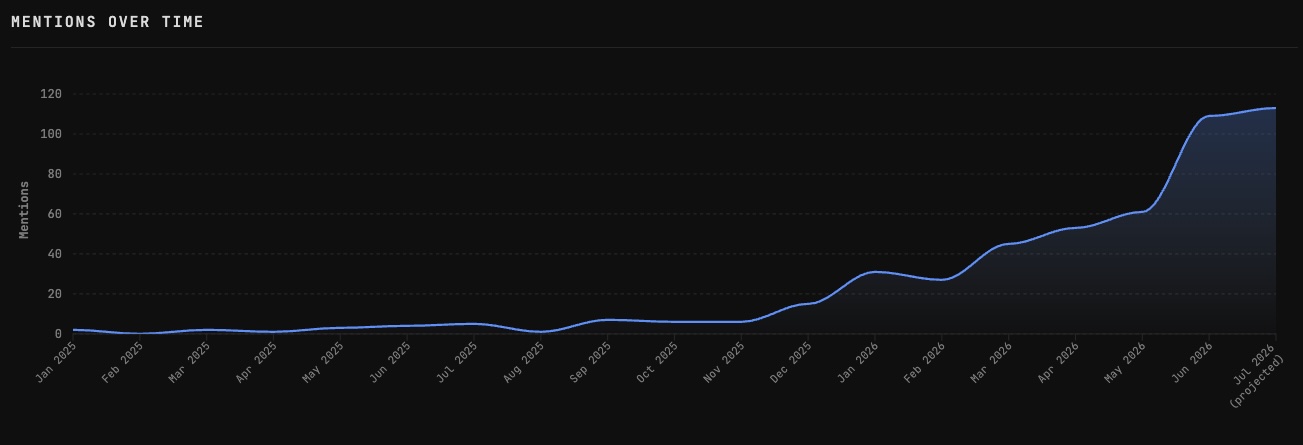
I'd expect this trend to continue, though the term "graph engineering", which is a separate but closely related trend, may end up overtaking or dampening the loop engineering trend over time.
Interesting content specific to loop engineering
There are two posts that show loop engineering is moving from explainer content into product features and positioning:
-
Port's Agentic Engineering 2.0 from July 27th. Port, an internal developer portal, frames "loop engineering" as "Agentic 2.0" where agents are given goals rather than paths and operate in a continuous act-observe-adjust cycle. The post is explicitly positioning Port's platform as the context and governance layer this model requires. I'm skeptical of this approach as these models are simply not able to self-correct, but we'll see if this becomes more feasible in the post-Fable model world.
-
Linear's Introducing Loops published on July 20th. Linear launched a product feature called Loops, which are recurring agent workflows for teams, and in the announcement explicitly named "loop engineering" as an established practice in tools like Claude Code and Codex. Linear's new feature is one of the first concrete implementations of loop engineering added to a product.
There is also a cluster of posts from inference and infrastructure companies such as Baseten, JFrog, OpenRouter, Wundergraph, and Datadog that address the cost and reliability consequences of running agent loops. Baseten's Kimi K3 tokenization post explains that million-token agentic loops make tokenization time non-negligible for the first time. JFrog's post on model routing backfiring argues that switching models mid-session in multi-turn agent loops destroys prompt cache savings, turning a cost-reduction strategy into a cost amplifier. OpenRouter's post on prompt caching and sticky routing is essentially a guide to making agent loops cheaper to run.
Prompts to dig in further using Plushcap MCP
All of Plushcap's Loop Engineering data is available in the web app, API, and the Plushcap MCP server. Here are a few useful prompts that can be used to dig in further after connecting the MCP server to your LLM of choice:
-
Use Plushcap to perform a content gap analysis by reviewing all blog posts mentioning loop engineering, agent loops, or agentic loops in the 52-week window ending July 2026. Which technical questions, such as state management across loop iterations, cost accounting per loop turn, or testing non-deterministic loop behavior, appear most frequently in the posts but receive the least depth?
-
Which competitive spaces (i.e. inference providers, observability vendors, developer portals, framework maintainers) and companies are most underinvested in loop engineering content and how can they address those gaps—or how can their competitors exploit them?
-
Use Plushcap MCP to compare how Orkes, Arize, Cockroach Labs, Port, and LangChain each define or frame "loop engineering" in their posts from June to July 2026. Where do their definitions conflict, particularly around whether the loop is an inner agent mechanism or an outer scaffolding layer, and what does that divergence suggest about which competitive space is most likely to own the term's definition going forward?
-
Run a check for "graph engineering" on the loop engineering trend with Plushcap. Pull posts from the LangChain, Prefect, and Port company blogs over the past 90 days that mention both loop engineering and graph engineering. Assess whether "graph engineering" is a replacement for, an extension of, or a parallel alternative to loop engineering, and which framing is more common across the AI agents and durable execution competitive spaces.